I have created this blog to help my students learn and improve their English.
In this blog, they can find some interesting articles, grammar suggestions, exercises and assignments, pictures and videos.
This blog will help students practice their speaking and listening, and do some grammar exercises.
In your blogs write about your favorite season or weather. You can write about the weather in your native country or any other place in the world. These questions will give you some ideas about your writing and help your to write a very nice paragraph. Read them carefully, please.
Good luck,
Irena
QUESTIONS:
What's your favorite season and why? What do you like better - hot weather or cold weather? Do you like snow? rain? Do you have snow in your country? Do you have hail? What month gets the most rain in your country? What month gets the most rain around here, in Seattle? What's the average temperature in your country in the summer time? Are there any special traditions associated with different seasons in your country? What kind of climate do you prefer when choosing a place to go on vacation? What is the best season to get married? What activities can you think of in your favorite season? What is the hottest season? What is the coldest season? What season is the most beautiful? Do you think weather affects the way people feel? What is the weather like in your country for each season?
You don't have to answer to these questions. Just read them and think what you want to write about the weather.
So, please, in your blogs write something about the weather or your favorite season.
This is the first post in the Spring Quarter. You have just learned new words and phrases about weather. You have practiced a dialog with those words. I hope you remember some of them and know what they mean. I have some more information for you. Please, take your time and read this post. Pay attention to every small detail, please. It will help you to talk about weather.
Best wishes,
Irena
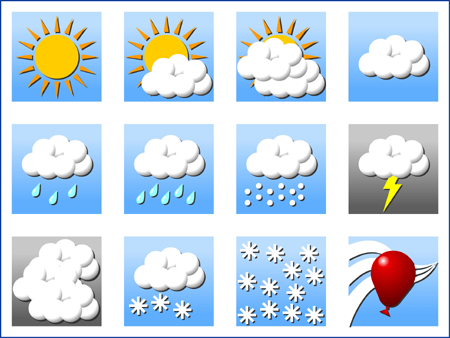
Let's talk about weather again. Let's review everything you've learned and even some more. English speakers (especially Americans) love to talk about weather. It is a way of starting a conversation.
People talk about the weather on the phone and in person. Friends and family talk about the weather before they discuss what's new. Co-workers talk about the weather before starting a hard day of work. Even strangers discuss the weather.
Learn the proper vocabulary and expressions, and you will find it easy to start a conversation anytime and anywhere with anyone you meet!
So people always talk about weather, and sometimes they start with a question:"How's the weather?" or "What's the weather like there?"
Common questions and answers about weather:
What's it like out? It's cold out.
How's the weather? It's ten below. (-10 degrees)
Do you have rain? We haven't had a drop of rain for weeks.
What's the temperature there? It's 22 degrees Celsius.
Beautiful day, huh? We couldn't ask for a better day than this.
What's the weather forecast? They're calling for blue skies all week.
Weather reports tell us what the weather is going to be like. We can listen to the weather report on the radio or on TV. We can also read the weather report in the newspaper or on the Internet. Weather reports help us decide what to wear. When it is hot we wear shorts, when it is cool we wear jackets, and when it is raining we carry umbrellas. We use a thermometer to measure the temperature.
Please, watch this video. It will help you remember different words and phrases about weather and understand them.
We are going to start with very simple things about weather. First, you ask a simple question about weather. You can ask:
How is the weather?
How is the weather today?
What's the weather like?
What's the weather like today?
Look at the following pictures and you'll know what the answers are.
How is the weather? It is hot. It is 99°. People go to the beach when it is hot.
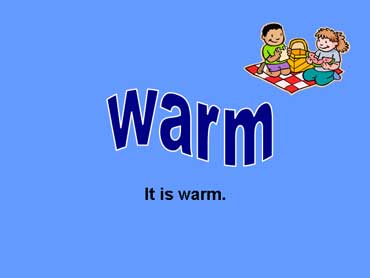
How is the weather?It is warm. It is 75°. People have picnics when it is warm.
How is the weather?It is cool. It is 55°. People go to cafes when it is cool.
How is the weather?It is cold. It is 40°. People go skiing when it is cold.
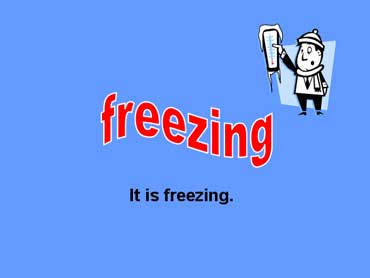
How is the weather?It is freezing. It is 32°. People stay inside and drink hot chocolate when it is freezing.
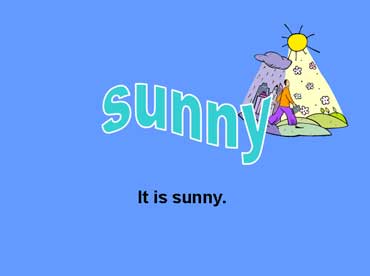
How is the weather?It is sunny. The sun is shining. The man is walking in the sunshine.
How is the weather?It is windy. The wind is blowing. The man is chasing his hat.
How is the weather?It is raining. There is a puddle on the ground. The woman is carrying an umbrella.
How is the weather?It is snowing. Snow is on the ground. The man and his son are building a snowman.
How is the weather?It is smoggy. Smoke is coming out of the factory. Smoke causes smog.
How is the weather?There is a tornado on the ground. Tornadoes are also called twisters. Tornadoes destroy houses and cars. Here are some moreweather words and phrases.You don't have to memorize all of them, but it's useful to read them and understand.
Avalanche (noun) - a dangerous slide of snow down a mountain.
The skiers were warned about a possible avalanche.
Below freezing - (preposition/adjective)- temperature less than 0 degrees Celsius/(32F).
It's supposed to go below freezing before the weekend.
Blizzard (noun)- a storm with lots of snow and wind.
The airplane couldn't take-off because of the blizzard.
Boiling hot (adjective + noun)- common expression for describing a very hot day.
It was boiling hot, so we all jumped into the lake.
Breeze (noun)- light wind.
Don't bother with a hat. There is always a breeze near the ocean.
Celsius (noun) -measurement of temperature (0 degrees is freezing/100 is boiling).
In the summer, the average temperature here is 20 degrees Celsius.
Chilly (adjective)- cold.
It's a bit chilly today, so I think you should wear a coat.
Clear (adjective)- when the sky is blue because no clouds are blocking the sun.
On a clear night you can see a lot of stars.
Cloud/cloudy (noun/adjective) - water in the sky that appears as a white or grey mass.
It may look cloudy in the morning, but the sun always comes out by afternoon.
Cold spell (adjective + noun) a period of colder than average weather. They're calling for a cold spell, so we put off our camping trip.
Cool (adjective) - temperature in between warm and cold.
The days were boiling hot, but the nights were cool and comfortable for sleeping.
Degrees (noun) - measurement for temperature.
I don't feel the heat until it's about forty degrees Celsius outside.
Drizzling (continuous verb) - raining slightly.
I think I'll take the dog for a walk. It's only drizzling now.
Drought (noun) - a long period with no rainfall.
Forest fires are a serious danger during a drought.
Fahrenheit (noun) - measurement of temperature (32 degrees is freezing/212 is boiling).
It was 100 degrees Fahrenheit when we got to San Francisco.
Flood (noun) - overflow of rain water.
The flood was so bad, our basement was full of water.
Flurries (noun) - very light snowfall.
There are a few flurries but the snow isn't sticking to the roads.
Fog/foggy (noun/adjective) - thick water vapor that blocks one's vision.
We couldn't see the bridge because there was too much fog.
Forecast (noun/verb) - the expected weather for the future.
According to the 5 day forecast, it's going to rain on our wedding day.
Freezing cold (adjective + noun) - common expression used to describe a very cold day.
It was a freezing cold day for the Santa Claus parade.
Frost (noun) - ice crystals on a frozen surface.
Some flowers are so strong they can withstand frost.
Frostbite (noun) - a skin condition caused by over exposure to the cold (typically reddish skin with white spots).
I lost my hat while I was skiing, and I ended up with frostbite on my ears.
Hail (noun) small pieces of ice that fall during a storm.
There was so much hail that some of the trailer homes were destroyed.
Heat stroke (noun) - a flu-like condition one can acquire after spending too long in the sun. Bring lots of water and wear a hat to avoid heat stroke in this weather.
Heat-wave (noun) - extremely hot weather that is much higher than average - usually lasts a short time.
During the heat-wave we cooled our beds down with ice packs.
Humid/humidity (adjective/noun) - moisture in the air.
It feels a lot hotter than it actually is because of the humidity.
Hurricane (noun) - a tropical storm with very strong wind and rain (from Atlantic Ocean); from Pacific Ocean it is called a "typhoon"; from Indian Ocean it is called a "cyclone."
Half of the buildings on the island were flattened by the hurricane.
Icy (adjective) - slippery because of ice.
The roads are icy so please avoid driving down any hills.
Lightning (noun) - electric flash caused by two clouds hitting.
The outdoor pool always closes when the lifeguards suspect lightning.
Mild (adjective) - temperature that is warmer than average(in a cold season).
It's quite mild out so I didn't bother with a hat or mittens.
Meteorologist (noun) - a person who studies weather patterns.
The meteorologist predicted that the cold spell would be over by now.
Minus/negative (adjective) - indicates that a temperature is below zero.
It was minus twenty degrees at the top of the hill.
Overcast (adjective) - no sun is visible.
The sky is overcast this morning, but the sun is supposed to come out by late afternoon.
Partly cloudy (adverb + adjective) - term often used in a weather forecast to indicate that the skies are sunny and cloudy at the same time.
Tomorrow's forecast is partly cloudy with clear skies by nightfall.
Puddle (noun) - collection of rain water.
Children love to splash in puddles when they are wearing rubber boots.
Rain/raining/rainy (noun/continuous verb/adjective) - water that falls to earth.
My hair is all wet and messy from the rain.
Raindrop (noun) - a single measurement of rain.
I love catching raindrops on my tongue.
Rainbow (noun) - a band of colors found in the sky after a rainfall.
According to legend you can find a pot of gold at the end of a rainbow.
Raining cats and dogs (idiom) - raining heavily.
They cancelled the football game because it was raining cats and dogs.
Scorching/a scorcher (adjective/noun) - extremely hot temperature/a very hot day.
It was a scorcher, so the whole family slept in the cool basement.
Season (noun) - time of year characterized by certain weather - Winter, Spring, Summer, Fall (or Autumn).
My favorite season is Fall, because I love to watch the leaves changing colors.
Shower (noun) - quick/light rainstorm.
They've been calling for showers all week, but so far it's been dry.
Sleet (noun) - similar to hail; rain that freezes as it falls.
All-weather-tires are best if you have to drive in sleet.
Slush/slushy (noun/adjective) - snow on the ground that has been rained on.
The snow turned to slush as soon as it started to rain.
Smog (noun) - heavy,dark cloud cover caused by pollution.
You really notice the smog downtown in this type of humidity.
Snow/snowy/snowing (noun/adjective/ continuous verb) - frozen water that warms slightly as it falls to earth.
It is already snowing up in the mountains, so the ski season should be great this year.
Snowstorm (noun) - large amounts of wind and snow.
All of the schools were closed because of the snowstorm.
Sun/sunshine/sunny (noun/noun/adjective) - the gassy star that warms the earth.
We hope to have sunshine on the day of the beach picnic.
Sunburn (noun) - painful red/pink skin caused by being in the sun too long.
The bald man got a sunburn on his head.
Temperature (noun) - how warm or cold the air is.
Can you check the temperature before we get dressed for our walk?
Thermometer (noun) - instrument for measuring the temperature of the air. When I checked the temperature this morning, the thermometer said it was already thirty degrees Celsius.
Thunder/thunderstorm (noun) - the crashing of clouds (often followed by a strike of lightning and heavy rain).
Let's close all of the windows. It looks like a thunderstorm is coming.
Tornado (noun) - violently spinning windstorm.
The tornado picked up everything in its path, including animals and cars.
Wind/windy (noun/adjective) - blowing air outside.
It's too windy to play golf today.
Wind chill factor (noun) - when the wind makes the air feel colder than the actual temperature.
It's minus two, but with the wind chill factor it's minus fifteen.
Now, after you've learned a lot of weather words and phrases, try to do this exercise. Just click on this link.
And here is an unusual practice conversations with Mike. You can ask him many different question, and he will answer you. It' very interesting because he know the answers to every question you can ask him. It's fun!
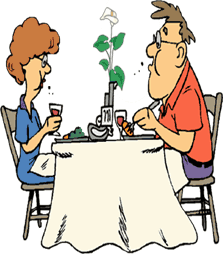
Dear students, Today we are going to learn the names of some food and drinks and learn how to order some food in the restaurant. Watch these videos and try to remember everything. If you have questions, ask me. I'm here for you. Good luck and have fun. Irena
WELCOME TO OUR RESTAURANT!
#1
#2
#3
#4
#5
#6
Now watch the video about some food you can eat in a restaurant. Listen, read and repeat.
Now we are going to learn how to order in a restaurant. Listen carefully, take notes and repeat.
This video will help you to use appropriate phrases and sentences that people usually use when they order food in a restaurant. The teacher in this video is going to explain to you 4 different ways of doing it. Please, watch it.
Here is one more video for you. It will teach you how to order food.
When you're out to eat with friends and family, it can be challenging to decide what to order off the menu. There are often too many choices on the menu, everything sounds good or nothing sounds good; you're unfamiliar with a particular type of cuisine; you'd like to have what that woman over there is having, but you don't know what that is.
Please, also watch this video. It's easy to understand and easy to remember some standard phrases and rules ordering in a restaurant.
So, one of the most important tasks in English is ordering food when you go to a restaurant. There are basic forms and questions. There is also a food vocabulary that you can use in places where people speak English.
Take a look at this Menu Starters: Chicken Soup $2.50 Salad $3.25 Sandwiches - Main Course Ham and cheese $3.50 Tuna $3.00 Vegetarian $4.00 Grilled Cheese $2.50 Piece of Pizza $2.50 Cheeseburger $4.50 Hamburger deluxe $5.00 Spaghetti $5.50 Drinks: Coffee $1.25 Tea $1.25 Soft Drinks - Coke, Sprite, Root Beer, etc. $1.75 Read this dialogue: Waiter: Hello, Can I help you? Kim: Yes, I'd like to have some lunch. Waiter: Would you like a starter? Kim: Yes, I'd like a bowl of chicken soup, please. Waiter: And what would you like for a main course? Kim: I'd like a grilled cheese sandwich. Waiter: Would you like anything to drink? Kim: Yes, I'd like a glass of Coke, please.After Kim has her lunch. Waiter: Can I bring you anything else? Kim: No thank you. Just the bill. Waiter: Certainly. Kim: I don't have my glasses. How much is the lunch? Waiter: That's $6.75. Kim: Here you are. Thank you very much. Waiter: You're welcome. Have a good day. Kim: Thank you, the same to you. Notice how the waiter asks:- What would you like? and Kim responds: - I'd like ... "Would like" is the polite form used when asking and requesting. Now, try this easy exercise. Fill in the blanks. Waiter: Hello, Can I ______ you? Kim: Yes, __________ to have some lunch. Waiter: _____________________ a starter? Kim: Yes, _____________ a bowl of chicken soup, please. Waiter: And _____________________ for a main course? Kim: I'd like a grilled cheese sandwich. Waiter: ________________ anything to drink? Kim: Yes, I'd like a glass of Coke, please. Waiter (after Kim has her lunch): Can I bring you anything else? Kim: No thank you. Just the ________ . Waiter: Certainly. Kim:I don't have my glasses. ________________ is the lunch? Waiter: That's $6.75.Kim: ______________ . Thank you very much. Waiter: You're ___________ . Have a good day. Kim: Thank you, the ________ to you. Here is a dialog at the restaurant. Please, practice it a few times. Make sure, you remember what you have to say.
Waiter: Welcome to Antico's restaurant. Here are your menus. Today's special is grilled salmon. I'll be back to take your order in a minute. ............................................... Waiter: Are you ready to order? Customer 1: I'd like the seafood spaghetti. Waiter: And you? Customer 2: I'll have a hamburger and fries. Waiter: Would you like anything to drink? Customer 1: I'll have a coke, please. Waiter: And for you? Customer 2: Just water, please. Waiter: OK. So that's one seafood spaghetti, one hamburger and fries, one coke, and one water. I'll take your menus. ................................. Waiter: Here is your food. Enjoy your meal. ................................. Waiter: How was everything? Customers 2: Delicious, thanks. Waiter: Would you like anything for dessert? Customer 1: No, just the bill please. And at the end, here is one last video.
So did you learn some new words and phrases that you can use in a restaurant next time you go there to eat? I hope you say "Yes"!
Did you have fun? I hope you say "Yes"!
So, now you can go to a restaurant, try to use all phrases you learned and practice them with your waiter.
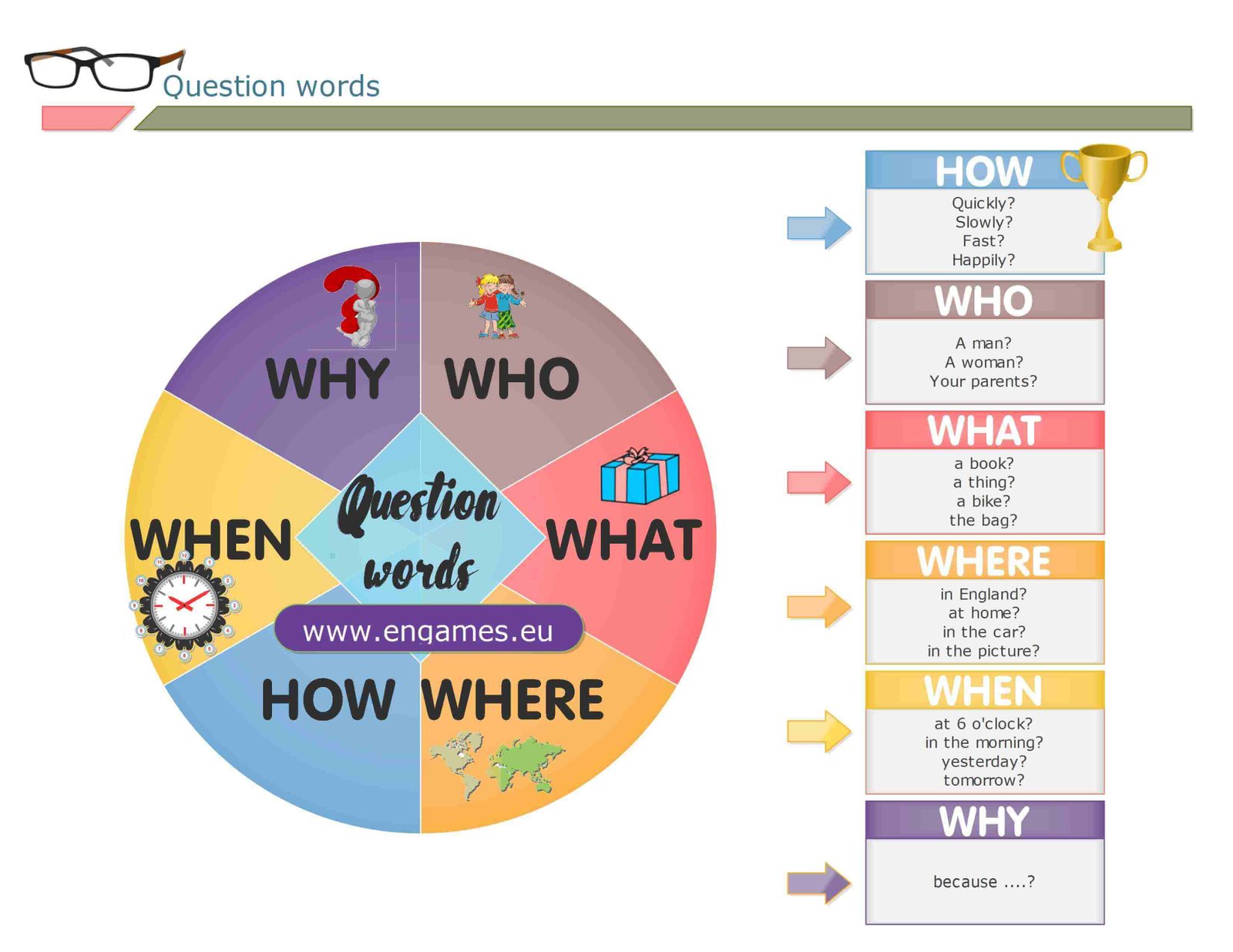
Dear students, Last Thursday we started learning different types of questions and wh-words (or question words). Here is more information to review this grammar. I've also posted some exercises for you to practice it. I hope you like it. Good luck and have fun. Irena
Basic types of questions
There are 3 basic types of question:
Yes/No Questions - the answer to the question is "Yes" or "No"
Wh- Questions - the answer to the question is "Information"
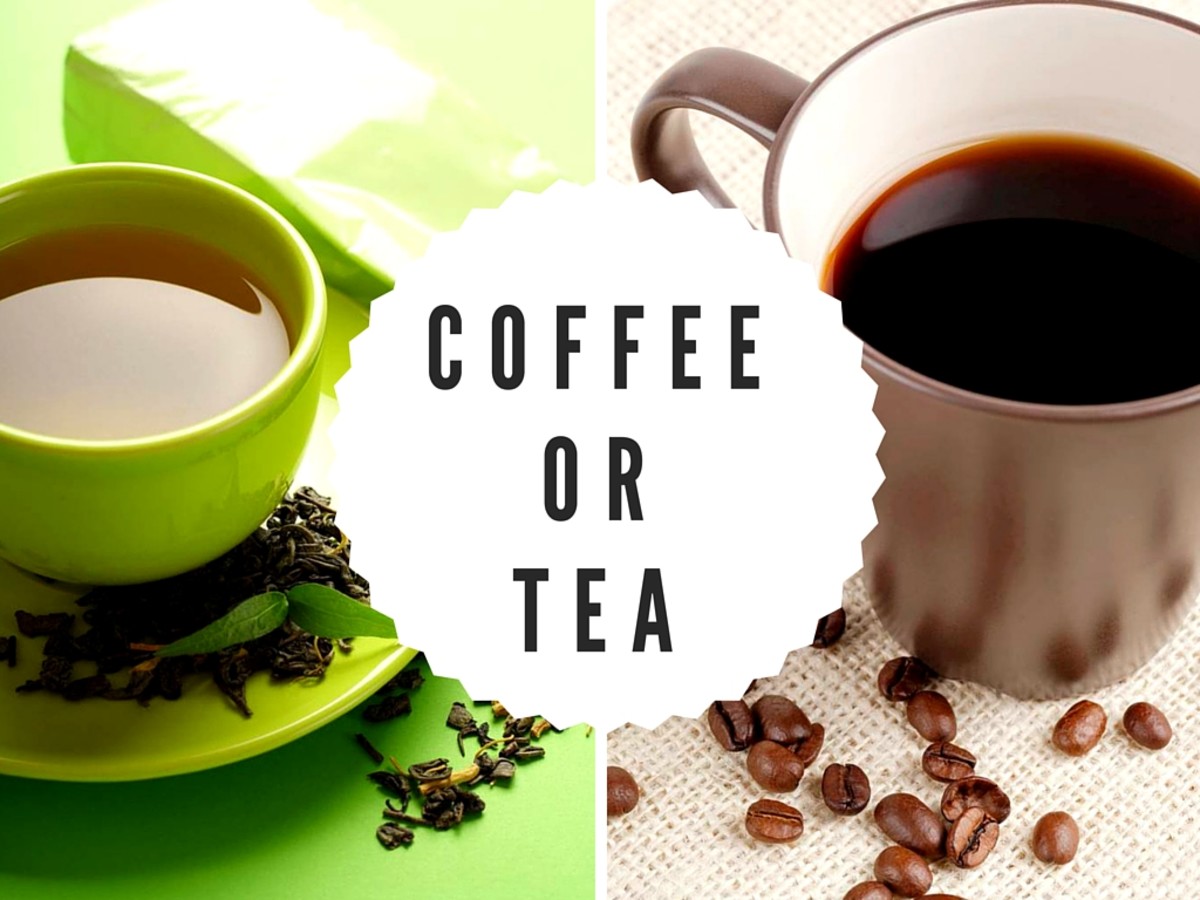
Choice Questions ("or" questions) - the answer to the question is "in the question"; you are given a choice of two or three different things
1. Yes/No Questions
auxiliary verb
subject
main verb
Answer Yes or No
Do
you
work
here?
No, I don’t.
Does
she
read
a lot?
Yes, she does.
Can
you
drive
me home?
No, I can't.
Can
he
help
me?
Yes, he can.
Is
Anne
French?
Yes, she is.
Was
Marc
at home?
No, he wasn't.
Are
you
single?
Yes, I am.
Were
you
at home yesterday?
No, I wasn’t.
Is
he
reading
a book?
Yes, he is.
Are
you
studying
English?
No, I’m not.
2. Wh- Questions
question word
auxiliary verb
subject
main verb
Answer Information
Where
do
you
live?
In Paris.
Where
does
your sister
work?
At the bookstore.
Who
knows
the answer?
I do.
Who
is
calling?
Your friend.
Where
is
Bombay?
In India.
How
was
your day?
Great.
What
are
we
having
for lunch?
Fish and vegetables.
3. Choice Questions ("or" questions)
auxiliary verb
subject
main verb
OR
Answer In the question
Do
you
want
tea
or
coffee?
Coffee, please.
Does
he
run
fast
or
slowly?
Fast.
Is
your car
white
or
black?
It’s white.
Are
these shoes
$15
or
$50?
They are $50.
Is
she
reading
a magazine
or
a newspaper?
A newspaper.
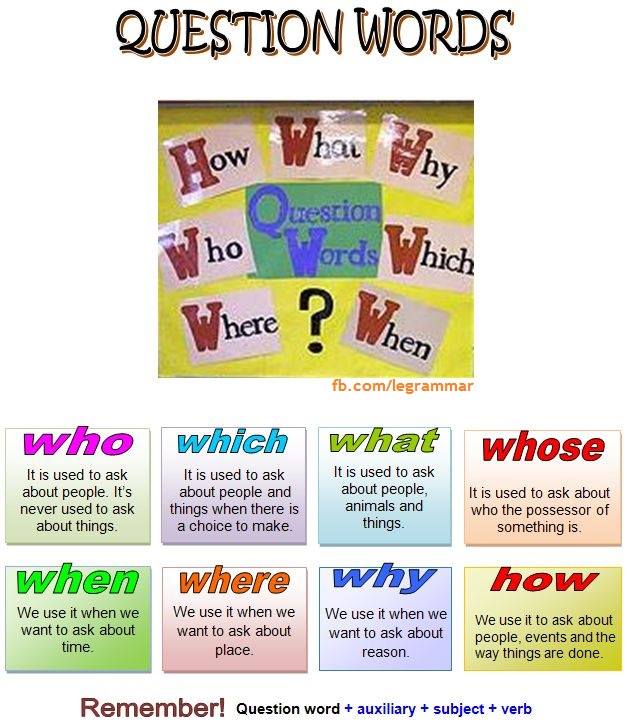
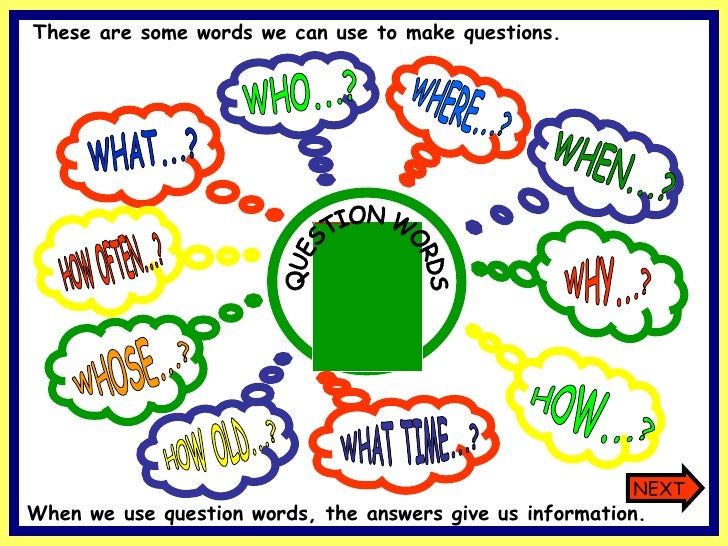
REMEMBER: What? - it's about a thing or an object. Who? - it's about a person or people. When? - it's about time (days, dates, months, years). Where? - it's about a place or location. Why? - It's about a reason. How? - it's about manner.
Let's talk about wh-words again. In class we've already talked about the meaning of each of these words. I'd like you to review all of them and memorize.
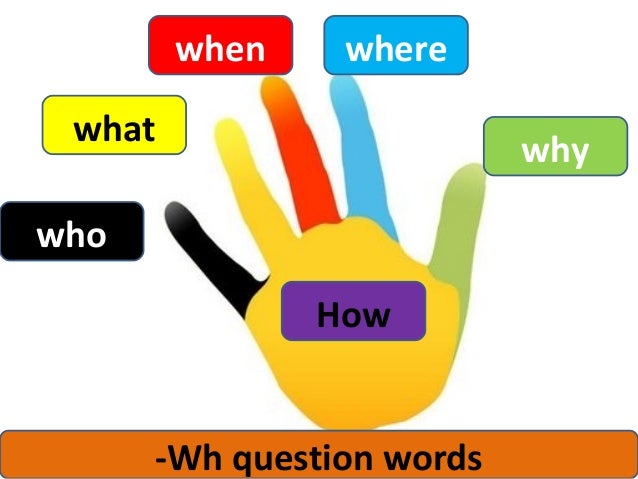
As you remember, wh-words start with 2 letters - "wh". That's where their name came from. We use question words to ask certain types of questions. We often call them wh-words because they include the letters wh- (for example why, how).
First, watch this video. It will help you to remember question words.
Here is another video with a lot of wh-questions. Listen and learn how to ask such questions.