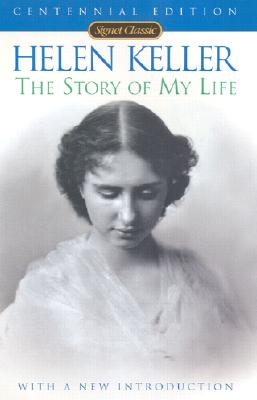
We have just finished reading the story of Helen Keller. Now I would like to give you some information about her.
Enjoy,
Irena
Helen Adams Keller was an American author, political activist, and lecturer. She was the first deaf-blind person to earn a bachelor of arts degree.

Synopsis
Helen
Adams Keller was born on June 27, 1880, in Tuscumbia, Alabama. In 1882, she was
stricken by an illness that left her blind and deaf. Beginning in 1887, Keller's
teacher, Anne Sullivan, helped her make tremendous progress with her ability to
communicate, and Keller went on to college, graduating in 1904. In 1920, Keller
helped found the ACLU. During her lifetime, she received many honors in
recognition of her accomplishments.

Helen
Keller was the first of two daughters born to Arthur H. Keller and Katherine
Adams Keller. She also had two older stepbrothers. Keller's father had proudly
served as an officer in the Confederate Army during the Civil War. The family
was not particularly wealthy and earned income from their cotton plantation.
Later, Arthur became the editor of a weekly local newspaper, the North
Alabamian.
Keller
was born with her senses of sight and hearing, and started speaking when she was
just 6 months old. She started walking at the age of one.
Loss of Sight and Hearing
In 1882, however, Keller contracted an illness—called
"brain fever" by the family doctor—that produced a high body
temperature. The true nature of the illness remains a mystery today, though
some experts believe it might have been scarlet fever or meningitis. Within a
few days after the fever broke, Keller's mother noticed that her daughter
didn't show any reaction when the dinner bell was rung, or when a hand was
waved in front of her face. Keller had lost both her sight and hearing. She was
just 19 months old.

As
Keller grew into childhood, she developed a limited method of communication
with her companion, Martha Washington, the young daughter of the family cook.
The two had created a type of sign language, and by the time Keller was 7, they
had invented more than 60 signs to communicate with each other. But Keller had
become very wild and unruly during this time. She would kick and scream when
angry, and giggle uncontrollably when happy. She tormented Martha and inflicted
raging tantrums on her parents. Many family relatives felt she should be
institutionalized.

Looking
for answers and inspiration, in 1886, Keller's mother came across a travelogue
by Charles Dickens, American Notes. She read of the successful
education of another deaf and blind child, Laura Bridgman, and soon dispatched
Keller and her father to Baltimore, Maryland to see specialist Dr. J. Julian
Chisolm. After examining Keller, Chisolm recommended that she see Alexander
Graham Bell, the inventor of the telephone, who was working with deaf children
at the time. Bell met with Keller and her parents and suggested that they
travel to the Perkins Institute for the Blind in Boston, Massachusetts. There,
the family met with the school's director, Michael Anagnos. He suggested Helen
work with one of the institute's most recent graduates, Anne Sullivan. And so
began a 49-year relationship between teacher and pupil.

On
March 3, 1887, Sullivan went to Keller's home in Alabama and immediately went
to work. She began by teaching six-year-old Helen finger spelling, starting
with the word "doll," to help Keller understand the gift of a doll
she had brought along. Other words would follow. At first, Keller was curious,
then defiant, refusing to cooperate with Sullivan's instruction. When Keller
did cooperate, Sullivan could tell that she wasn't making the connection
between the objects and the letters spelled out in her hand. Sullivan kept
working at it, forcing Helen to go through the regimen.

As
Keller's frustration grew, the tantrums increased. Finally, Sullivan demanded
that she and Keller be isolated from the rest of the family for a time, so that
Keller could concentrate only on Sullivan's instruction. They moved to a
cottage on the plantation.

In
a dramatic struggle, Sullivan taught Keller the word "water"; she
helped her make the connection between the object and the letters by taking
Keller out to the water pump, and placing Keller's hand under the spout. While
Sullivan moved the lever to flush cool water over Keller's hand, she spelled
out the word w-a-t-e-r on Helen's other hand. Keller understood and repeated
the word in Sullivan's hand. She then pounded the ground, demanding to know its
"letter name." Sullivan followed her, spelling out the word into her
hand. Keller moved to other objects with Sullivan in tow. By nightfall, she had
learned 30 words.

In
1890, Keller began speech classes at the Horace Mann School for the Deaf in
Boston. She would toil for 25 years to learn to speak so that others could
understand her. From 1894 to 1896, she attended the Wright-Humason School for
the Deaf in New York City. There, she worked on improving her communication
skills and studied regular academic subjects.
Around
this time, Keller became determined to attend college. In 1896, she attended
the Cambridge School for Young Ladies, a preparatory school for women. As her
story became known to the general public, Keller began to meet famous and
influential people. One of them was the writer Mark Twain, who was very
impressed with her. They became friends. Twain introduced her to his friend
Henry H. Rogers, a Standard Oil executive. Rogers was so impressed with
Keller's talent, drive, and determination that he agreed to pay for her to attend Radcliffe College.
There, she was accompanied by Sullivan, who sat by her side to interpret
lectures and texts.

By
this time, Keller had mastered several methods of communication, including
touch-lip reading, Braille, speech, typing, and finger-spelling. With the help
of Sullivan and Sullivan's future husband, John Macy, Keller wrote her first
book, The Story of My Life. It covered her transformation from
childhood to a 21-year-old college student. Keller graduated, cum laude, from
Radcliffe in 1904, at the age of 24.
In
1905, Sullivan married John Macy, an instructor at Harvard University, a social
critic and a prominent socialist. After the marriage, Sullivan continued to be
Keller's guide and mentor. When Keller went to live with the Macys, they both
initially gave Keller their undivided attention. Gradually, however, Anne and
John became distant to each other, as Anne's devotion to Keller continued
unabated. After several years, they separated, though were never divorced.

After
college, Keller set out to learn more about the world and how she could help
improve the lives of others. News of her story spread beyond Massachusetts and
New England. She became a well-known celebrity and lecturer by sharing her
experiences with audiences and working on behalf of others living with
disabilities. Throughout the first half of the 20th century, Keller tackled
social and political issues, including women's suffrage, pacifism, and birth
control. She testified before Congress, strongly advocating to improve the
welfare of blind people. In 1915, along with renowned city planner George
Kessler, she co-founded Helen Keller International to combat the causes and
consequences of blindness and malnutrition. In 1920, she helped found the
American Civil Liberties Union.

When
the American Federation for the Blind was established in 1921, Keller had an
effective national outlet for her efforts. She became a member in 1924 and
participated in many campaigns to raise awareness, money, and support for the
blind. She also joined other organizations dedicated to helping those less
fortunate, including the Permanent Blind War Relief Fund (later called the
American Braille Press).

Soon
after she graduated from college, Keller became a member of the Socialist
Party, most likely due in part to her friendship with John Macy. Between 1909
and 1921, she wrote several articles about socialism and supported Eugene Debs,
a Socialist Party presidential candidate. Her series of essays on socialism,
entitled "Out of the Dark," described her views on socialism and
world affairs.

It
was during this time that Keller first experienced public prejudice about her
disabilities. For most of her life, the press had been overwhelmingly
supportive of her, praising her courage and intelligence. But after she
expressed her socialist views, some criticized her by calling attention to her
disabilities. One newspaper, the Brooklyn Eagle, wrote that her
"mistakes sprung out of the manifest limitations of her development."

In
1936, Keller's beloved teacher and devoted companion, Anne Sullivan, died. She
had experienced health problems for several years and, in 1932, lost her
eyesight completely. A young woman named Polly Thomson, who had begun working as a secretary for Keller
and Sullivan in 1914, became Keller's constant companion upon Sullivan's death.

In
1946, Keller was appointed counselor of international relations for the
American Foundation of Overseas Blind. Between 1946 and 1957, she traveled to
35 countries on five continents. In 1955, at age 75, Keller embarked on the
longest and most grueling trip of her life: a 40,000-mile, five-month trek
across Asia. Through her many speeches and appearances, she brought inspiration
and encouragement to millions of people.

Now you can watch the movie about Helen Keller
"The story of my life"
She was a very smart woman.
Read her quotes:







Books she wrote: